
India is navigating a complex diplomatic landscape, attempting to balance its 'forever honeymoon' with the Israel-UAE-Bahrain axis against its historical ties with Iran, as evidenced by recent high-level visits and evolving geopolitical realignments in the Middle East, observes Ambassador M K Bhadrakumar.

Italian Prime Minister Giorgia Meloni's new book, 'Giorgia's Vision', reveals anecdotes from her 2023 India visit, including the widespread 'Welcome' posters and a joke about her popularity in New Delhi. She also shares insights into her diplomatic approach, emphasising personal connections over rigid formalities, and recounts interactions with various world leaders.

External Affairs Minister S Jaishankar met his Chinese counterpart Wang Yi in Manila, reiterating that peace and tranquillity in border areas are prerequisites for normal India-China relations. He stressed the importance of mutual respect, interest, and sensitivity, while also raising concerns about market access, trade imbalance, and supply chain uncertainties.

US President Donald Trump has reportedly urged Israeli Prime Minister Benjamin Netanyahu to withdraw Israeli military units from southern Syria and Lebanon, warning that Israel's continued presence could escalate regional tensions.

Canadian Prime Minister Mark Carney playfully attempted to recruit Norwegian football star Erling Haaland for Canada's World Cup squad during a NATO summit meeting with Norwegian Prime Minister Jonas Gahr Stoere, who humorously declined the offer.

The United States military is scheduled to complete its withdrawal from Iraq by September 30, marking the end of a 23-year deployment that began with the 2003 invasion and later focused on combating the Islamic State group.

US Ambassador to India Sergio Gor revealed that President Donald Trump views Prime Minister Narendra Modi as 'a friend' and is deeply committed to enhancing cooperation with New Delhi, highlighting their personal equation as a crucial factor in advancing bilateral ties.

US President Donald Trump lauded Prime Minister Narendra Modi's 'calm, cool, killer' persona at the G7 leaders' lunch in France, underscoring the deeply strategic relationship and formidable diplomatic skills of the Indian leader ahead of their crucial bilateral meeting.

The harsh truth is that the US is no longer a reliable partner, cautions Ramesh Menon.

Israeli Prime Minister Benjamin Netanyahu announced a significant policy shift, declaring that Israel's robust economy no longer requires American financial assistance. He also reiterated strong opposition to Palestinian statehood, affirmed an aggressive national defence strategy, warned of pre-emptive strikes against Iran, and confirmed the continued military presence in southern Lebanon.

In the present hyper-connected world, there are many domestic and global factors that affect financial markets. Of them, the most powerful and often least predictable are geopolitical events, which often boil down to one diplomatic headline.

Poland's Secretary of State, Wladyslaw T Bartoszewski, has credited Prime Minister Narendra Modi with preventing Russian President Vladimir Putin from using tactical nuclear weapons in Ukraine in late 2022, highlighting Modi's significant influence on the Russian leader.

For the foreseeable future, the most likely outcome remains continuation of the status quo. Taiwan will remain self-governing without formally declaring independence, while China continues to apply sustained pressure short of war, predict Krishnan Srinivasan and Manoj Mohanka.

Prime Minister Narendra Modi addressed his Japanese counterpart Sanae Takaichi as his 'younger sister' and hailed her as a 'visionary and popular leader' during a joint press meet, where both leaders unveiled initiatives to deepen bilateral cooperation and strengthen the India-Japan Special Strategic and Global Partnership.
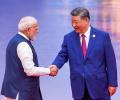
India's dual pursuit of a robust strategic partnership with Washington and a pragmatic, tension-management policy with Beijing represents the essence of modern multi-alignment. By embracing economic pragmatism, learning to compartmentalize political differences, and engaging in continuous dialogue, India can secure its borders, grow its economy, and contribute to a stable, multipolar Asian century, points out Ambassador Rajasekhar.
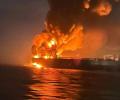
India's foreign policy establishment is adjusting with alacrity in real time -- an extraordinary spectacle in itself, considering the manifest reluctance to indulge in public diplomacy critical of American moves, observes Ambassador M K Bhadrakumar.

US President Donald Trump announced a finalised peace deal between the US and Iran, set for signing on June 19 in Switzerland, with key figures like J D Vance, Steve Witkoff, and Jared Kushner from the US side, and Abbas Araghchi and Mohammad Bagher Ghalibaf representing Iran, alongside Pakistani mediators Field Marshal Asim Munir, Shehbaz Sharif, Ishaq Dar, and Mohsin Naqvi, playing crucial roles in the diplomatic breakthrough.

Congress leader Rahul Gandhi has strongly criticised Prime Minister Narendra Modi for his silence on the deaths of three Indian seafarers in US military strikes on commercial vessels, calling Modi a 'compromised PM' who lacks the courage to confront those responsible.
The State Department spokesperson said the US will continue to engage meaningfully with the people and officials of Khyber Pakhtunkhwa to foster economic ties, promote regional security, and advance the interests of the American people.

It is an unusual choice to depute a retired general for the funeral of a revered religious figure but a thoughtful one in an attempt to inject verve into the bilateral relationship and restore the equilibrium in India's West Asian policies, notes Ambassador M K Bhadrakumar.

The question nobody seems to ask is why a democracy should be silent when many of its citizens are concerned about the way the US is deviating from its traditional ways of consultation, cooperation and collaboration and moving away from traditional allies, asks Ambassador T P Sreenivasan.

National Security Adviser Ajit Doval held "constructive" talks with Chinese Foreign Minister Wang Yi in New Delhi, focusing on the normalisation of bilateral ties. The discussions reviewed recent developments and progress towards rebuilding trust after the eastern Ladakh border standoff. Both sides have implemented measures, including disengagement pacts and high-level meetings, to improve relations.

Notwithstanding the economic complementarities and the host of agreements for deepening economic relation on a host of areas, both sides share common viewpoints on the foreign policy domain and seek common grounds to serve as a counterweight to China, notes Dr Rajaram Panda.

'The flip side of this is that he won't hesitate to call out India if he thinks its policies are hurting US economic interests or border US foreign policy goals.'

Formerly Iran's second-largest oil customer, Indian financial institutions were forced to withhold crude oil payments following the 2018 US sanctions.
Israeli Prime Minister Benjamin Netanyahu has lauded India as a 'huge power' with a strong affinity for Israel, highlighting the growing partnership between the two nations despite global delegitimisation efforts against the Jewish state.

Top leaders from the US, Iran, and Pakistan, along with other nations, have gathered in Switzerland for high-level talks aimed at restoring peace in West Asia. These negotiations follow a recently signed Memorandum of Understanding between the US and Iran, initiating a 60-day window for a deal. Discussions focus on Iran's nuclear programme and the fragile interim peace deal, amidst renewed tensions and the fluctuating status of the Strait of Hormuz.

The visit was expected to project Assam as the gateway to Southeast Asia and reinforce the state's emergence as a preferred investment destination.

India and China held constructive talks on the situation along the Line of Actual Control (LAC) in eastern Ladakh, emphasising that maintaining border peace and tranquillity enabled progress in normalising overall relations.

The US and Iran have agreed on a roadmap aimed at reaching a final agreement within 60 days after hours-long talks at the Swiss resort of Burgenstock, mediators Qatar and Pakistan said on Monday, describing the progress as "encouraging."

The Beijing summit may have reduced immediate diplomatic uncertainty, but it did not resolve the deeper structural contest between the United States and China. That contest appears likely to define the coming decade, notes Varun Arya.
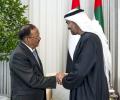
India is the only significant power that all parties trust, or at least do not distrust, notes former defence secretary Ajay Kumar.

India's procurement of Venezuelan crude oil has picked up momentum since April and the South American nation has already emerged as the third largest oil supplier to the country.

These modern Hindi films proved that the love triangle still has enough heartbreak, passion and chaos left to captivate audiences.

Few leaders since Independence have been able to establish such a direct connection with the electorate or shape the national conversation to the extent that Narendra Modi has done over the past decade, points out former Union minister Dr Karan Singh.

Iran's state broadcaster denies sending a diplomatic delegation to Pakistan for talks with the US, despite reports suggesting otherwise. This denial comes amid escalating tensions and aggressive rhetoric from Washington, even as signs of potential diplomatic movement emerge.

Chinese President Xi Jinping warned US President Donald Trump that mishandling the Taiwan issue could trigger conflicts between the two countries during wide-ranging talks on trade, Iran, and energy security.

Ebrahim Azizi, head of Iran's National Security Committee, stated that diplomatic talks with the US are governed by national interest and security, viewing negotiations as an extension of military efforts.

Prime Minister Narendra Modi and US Secretary of State Marco Rubio discussed various aspects of India-US bilateral ties, focusing on defence, trade, energy, and technology. Rubio extended an invitation from President Donald Trump for PM Modi to visit the US.

The Congress party has criticised the Modi government over Pakistan's involvement in US-Iran peace talks, calling it a 'monumental setback' for India's diplomatic efforts.
